

10 Designer Mindsets for Navigating “I Don't Know” Moments
How design thinking helps us move through uncertainty

“I don’t know” is a thought familiar to designers.
We start most projects with it. New clients, new industries, new problems we have never seen before. In every project, we move from not knowing, to knowing some, to knowing enough, to solving. With experience, I was able to see my lack of knowledge as a strength. Because I have something more powerful than answers.
I know how to move without them. And the unknown stops being something to fear and becomes a good place to start.
The world is shifting in this direction too.
For a long time, knowing was seen as intelligence. The people with the answers were the ones seen as valuable. But information is now available to everyone almost instantly, so “knowing” has lost its edge.
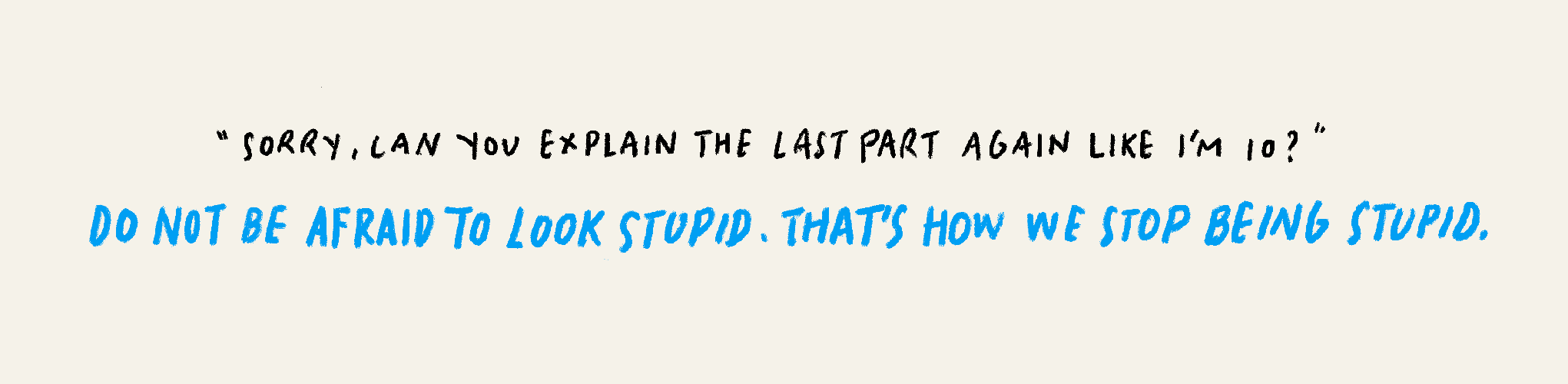
Our ability to learn, adapt, make sense of things and ask better questions is becoming the new definition of intelligence.
More people are realising that pretending to know does not take us anywhere. Honesty does. Curiosity does. Moving through uncertainty does.
And this isn’t just a design thing. It’s a human thing.
Parents know this space of not knowing better than anyone. At home, many of us expect ourselves to know because we are the adults. So our kids expect us to know too. Yet much of parenting is a series of “I don’t know” moments. I don’t know why she pulls all the hair off her dolls. I don’t know why she is so angry all the time. I don’t know why she doesn’t tell me anything.
The unknown shows up everywhere in our lives, big and small. The difference between the ones who thrive and the ones who barely survive lies in how we move through it.
I don’t know. But maybe learning how designers work through their daily unknowns can help others do the same, whether at home, at work or in life.
Below are the ten designer mindsets I rely on for different contexts. Experiment with them and notice what helps.
1. More often than not, success begins with not knowing
Experienced designers embrace not knowing. It is literally the start of our approach to problem-solving. The discovery phase exists because the beginning is unclear.
Starting with assumptions may feel more efficient, but it often leads to solving the wrong problem. Designers focus on learning first, then moving forward with better understanding.
At home, when big or multiple things don’t make sense, it may be a cue to explore further.
2. Stay Objective
Designers actively separate emotions from information. We try to keep our biases in check and bring conversations back to an objective space. We treat data as data and failure as feedback. This mindset keeps our diverse team grounded when working through difficult challenges.
At home, this is often much harder because things are personal. But that’s exactly why it matters. Preparing a more objective version of yourself before a difficult conversation often helps. For many of us, that version is simply our work self.
3. See people as collaborators
Designers see that even difficult people hold a piece of the puzzle. This mindset shifts the dynamic from conflict to collaboration and often leads to better outcomes.
At home, resistance often shifts when you treat the other person like a partner rather than a problem.
4. Assume you are missing something
Designers know assumptions are inevitable. So we choose the most useful one: that we’re probably missing something. This keeps us curious. We look beneath the surface to understand behaviours, motivations and emotional drivers. Curiosity often reveals things assumptions cannot.
At home, useful questions might be:
“What might be causing this behaviour?”
“What might they need from me that they are not expressing?”
5. Break it down
Big problems become solvable when they are broken into smaller pieces. Designers never try to solve a complex problem all at once. We first understand the landscape, narrow the focus, and tackle one part at a time.
At home, instead of asking “How do we make family life less chaotic?”, start by identifying the few things that are contributing most to the chaos and explore what might be driving them. One big problem feels impossible to act on. But when it’s broken into clusters of smaller problems, it becomes much more manageable.
6. Bias to action
Designers create clarity by acting. We gather clues, talk to people, test ideas and adjust things as we go. Action reveals information that thinking alone cannot.
At home, we may not know why someone is acting out. But experimenting with small changes in how we respond can reveal new insights.
7. Switch between zoomed in and zoomed out
Designers think like camera lenses. We zoom in to study details, then zoom out to understand the broader context. This helps us avoid tunnel vision and see patterns that might otherwise be missed.
At home, when a child’s behaviour triggers you, zoom out. Consider the environment, routines, relationships, and emotional context before zooming back in again.
8. Focus on the root causes
When designers don’t know what is really going on, we assume that what we see on the surface may only be a symptom. Instead of reacting to symptoms, we try to understand the deeper cause.
At home, it can sometimes feel like everything is wrong at once. A child may be rude, struggling with school work, fighting with siblings, and showing little care for hygiene. Rather than trying to fix each behaviour separately, step back and ask what might be behind them. Sometimes the root cause is something deeper, like emotional connection. When that improves, many of the smaller problems often begin to settle too.
9. Build trust in your approach
Designers rely on an approach that works across many contexts. We know it will eventually lead somewhere meaningful, even when the path is unclear. It’s like having a mental map. You may not know every turn ahead, but you know you are heading in the right direction.
Part of that confidence comes from understanding how you personally figure things out. I wrote more about this in my post Figuring Things Out, where I explore how people recognise their own patterns for navigating uncertainty.
At home, start small. Change one mindset or behaviour and notice the progress. The more you practise this way of thinking, the more confident you become navigating unfamiliar situations.
10. See multiple possibilities
Designers rarely assume there is only one right answer. When faced with a challenge, we naturally imagine several possible ways it could unfold.
Exploring alternatives helps us compare ideas, challenge assumptions and uncover options we may not have considered at first. Seeing multiple possibilities also changes how the problem feels. Instead of something heavy and intimidating, it begins to feel more like solving a puzzle. The more you train your mind to look for different possibilities, the more natural it becomes.
At home, when something is not working with a child or family dynamic, it is easy to feel stuck with one interpretation or response. The moment we allow ourselves to see more than one possibility, new solutions begin to appear.
Where these mindsets matter
These ten mindsets help me navigate every version of “I don’t know” I commonly face as a designer:
I don’t know where to start.
I don’t know what the problem is.
I don’t know enough or anything about this.
I don’t know if I am doing this right.
I don’t know how to work with these people.
When we learn to lean into the unknown instead of fighting it, something shifts. The more you do it, the more you learn to create the sense of mental safety you need to keep going. And with that safety, you grow braver for the next unknown.
I’d love to hear what are some of the mindsets you have used to navigate the unknown.