

Make sense of messy challenges with the Design Thinking Framework
Learn the steps, practise them, and eventually trust the process.

Designers rely on a clear thinking framework when they work. At the start, they may not know how everything will turn out, but they trust the process because they understand it, have used it many times, and know it can guide them from confusion to clarity.
Most of us follow processes or frameworks at work, but many of us do not have anything similar to guide our everyday personal lives. We react, assume, jump to solutions, and hope for the best.
Designers do not naturally transfer the way they think at work to other areas, too, myself included. It was only when I felt I had tried everything else with my kids and was desperate for a different solution that the thought came to me. When I saw the shift in myself and eventually the people around me, it was relatively easy for me to apply what I already knew in a new context, simply because I’m familiar with it.
To trust a process, we first need to know it and use it.
Over time, it becomes something that supports us when life gets overwhelming. And that is where the design thinking framework can be surprisingly helpful, and totally worth copying!
Design Thinking Framework
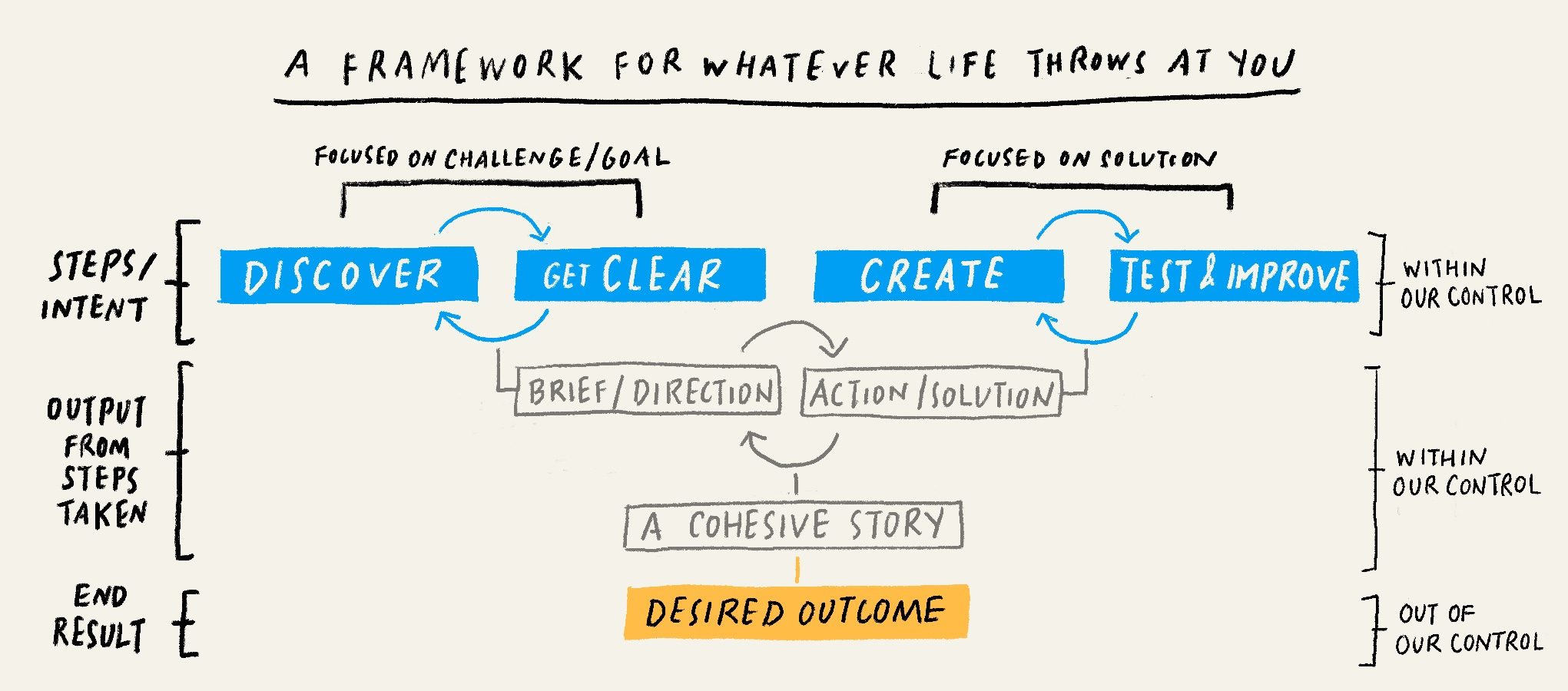
Understand the challenge objectively (Discover + Get Clear)
They take time to discover and understand what’s going on from multiple perspectives before deciding what truly needs attention. This is where they get curious, actively seek, observe, empathise, see patterns, and make sense of the bigger picture.Explore the solution beyond the obvious (Create + Test & Improve)
Once the problem is clear, they explore different possibilities before trying them out. This is where they actively create and improve as they go.
Each key step is supported by tools that help us stay objective as we seek, collect, simplify, create, and choose. Designers use different tools to make sense of what they find, but the real value is in how this way of thinking and working keeps us focused on what we can actually control. When we move through each step with intention, our decisions build on one another, widening our sense of possibility and guiding us towards the best we can do with what we know at that moment.
This all sounds like common sense, and most of us think we already do this. In reality, we often understand based on our biased assumptions and jump straight into solutions. But let’s keep our natural bias for efficiency for the small stuff. For anything with significance, it is worth the effort to think through the challenge in a structured way before moving to solutions.
Start putting it into practice
When we use this framework to think through everyday challenges, our thoughts will not appear in a neat, linear order. Our mind moves in loops. Ideas pop up without warning. We start to notice that our thoughts toggle between the four steps of the process (discover, get clear, create, improve).
The key is knowing which bucket a thought belongs to, and parking it there until we are ready to make sense of it. This keeps our thinking grounded rather than scattered. And once we get the hang of it, we feel more assured knowing that we can always look deeper and do better when we need to.
Related Posts: How Designers Think