

Figuring Things Out
Get better at navigating challenges by getting clear about your approach

Most of us are expected to figure things out as we go, especially the ones that are life- related. Relationships. Parenting. Big life changes. Problems, hurdles, roadblocks, whatever we call them, may be a normal part of life and often good for us in hindsight, but they are rarely greeted with much enthusiasm.
When I speak with parents about the challenges they are facing at home, I often sense overwhelm, helplessness, and frustration. “I know I need to spend more time with my kids, but I don’t even know where to start to find the time, or have the time to figure it out.”
Yet when I ask these same parents to walk me through how they solve a specific problem at home, many can describe their thoughts and actions, often with clarity after some nudging. But when I asked why they didn’t apply a similar method to their current challenge, the immediate response is usually…
“But it’s different!”
But is it really that different?
Know your Tools
Many of us are already very good at solving challenges, but often in contexts that are familiar to us.
Designers move between different problems every day. One day it might be improving customer experience at the airport. Another day it might be helping hospital staff deliver better patient care. Each project is different, yet designers return to a familiar way of thinking and adapt to the situation. The specific steps might differ, but the intention behind them stays the same. Over time, repeated use builds trust in the process, and new challenges feel less intimidating, and often pretty exciting.
This way of working is not exclusive to designers.
Most of us already have some version of a mental approach we rely on. We simply have not taken the time to translate it into the other parts of our lives. Without consciously adapting our process to different contexts, we default to “But this situation is different”. As a result, each new challenge feels like starting from scratch.
So we decided to give ourselves a new challenge.
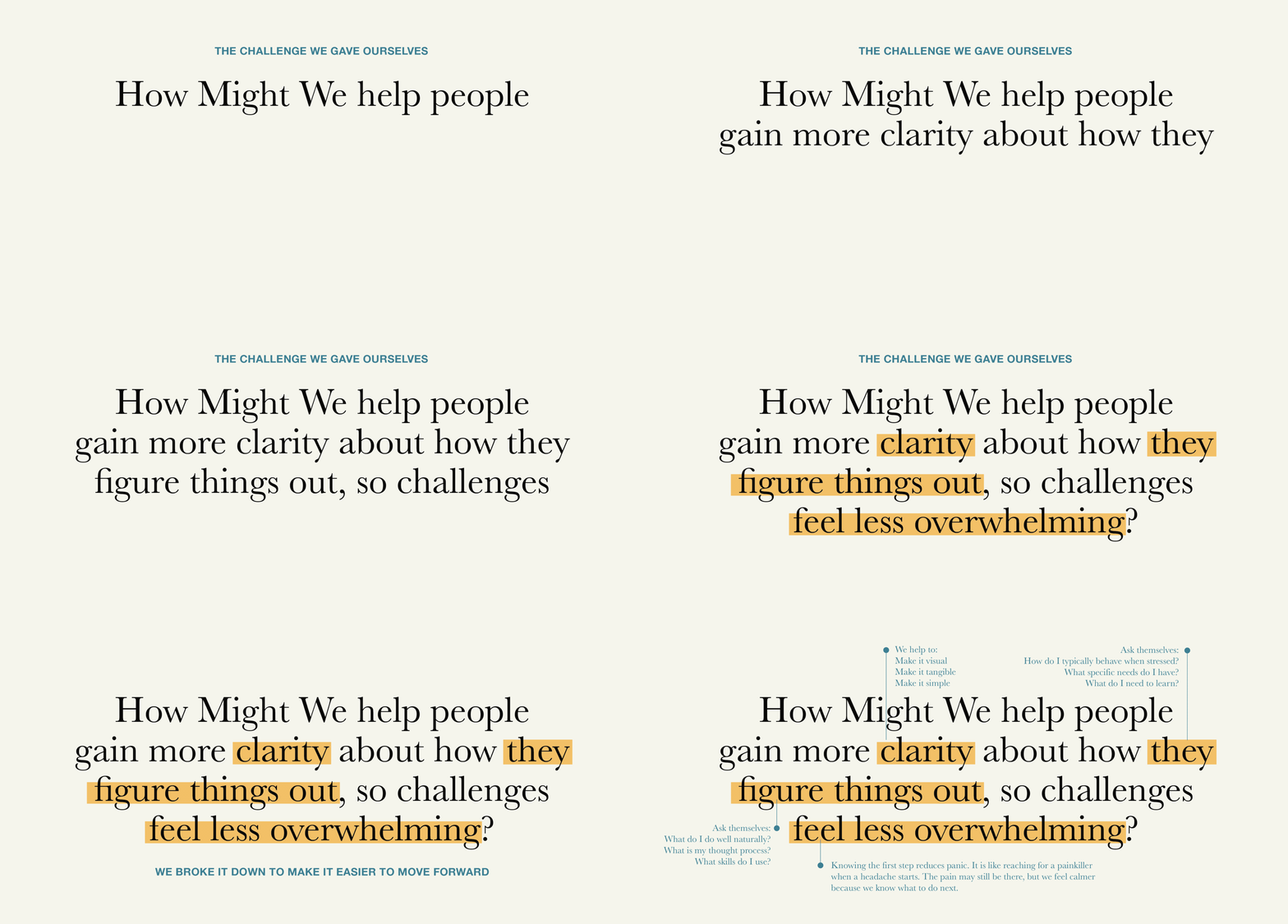
This led us to a metaphor to help guide people:
Imagine our mind is a workshop filled with tools. As we move through life, we pick up many tools along the way. Some we use often, some are forgotten, and some no longer serve us.
Whenever we face a challenge, we step into our mental workshop.
And for many of us, it looks something like this.

When challenges are familiar, we can still function pretty well because the tools we need are upfront and accessible. But when we face something new, the same messy workshop can quickly make us feel overwhelmed.
If the space were clear and organised, things would feel very different. We would know what tools we have, how to use them and have the working space to create new ones when needed. Problem-solving then would feel less stressful and become something we could lean into, get curious and even excited about.
Just like a home edit, our mental workshop needs regular care. Take things out. Keep what serves us, and let go of what does not. The goal is to curate a space with tools that are reliable, versatile, and used often. Knowing how we approach challenges makes our mental space feel lighter, and we stay capable without feeling overwhelmed.
Begin with this thinking guide
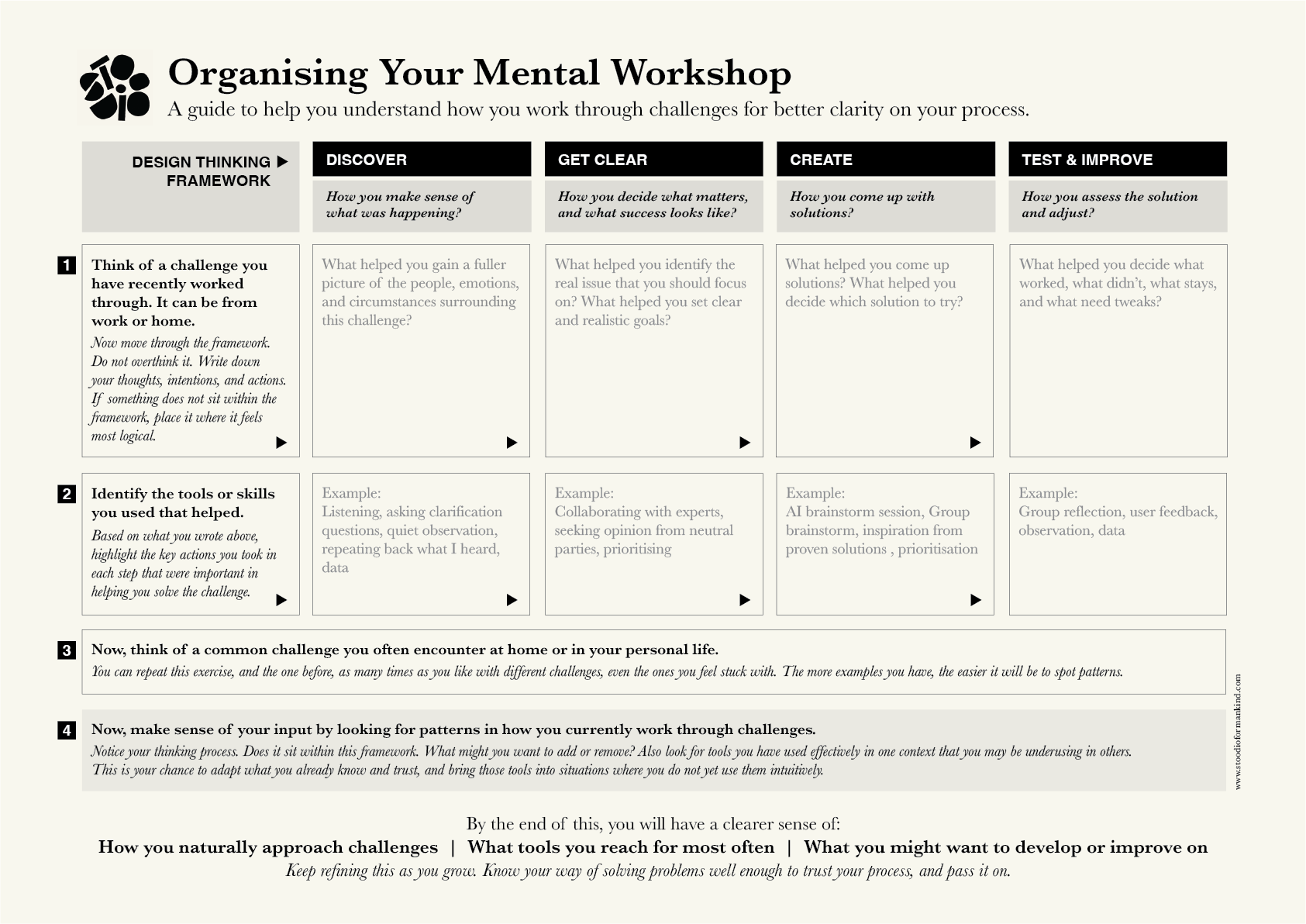
When I asked people to describe how they approach challenges, most of what they shared followed a familiar rhythm of thinking and doing that aligns with the design thinking framework, they just didn’t have a name for it.
To help you start, I created a thinking guide based on the framework to help you surface your own way of working things through.

Seeing the difference it makes
I learned the hard way that my proven methods for problem-solving that I’m very familiar with at work, do not naturally transfer to the rest of my life.
When my family moved halfway across the world, and the transition was hard on my children, I relied mostly on my instinct to optimise and fix quickly. The parts of my work that mattered way more at home, like collaboration, co creation, and being objectively curious, stayed tucked in my professional self. When I was dealing with a seemingly defiant, autonomy-seeking seven-year-old, the thought of facilitating a co creation session simply did not cross my mind!
It was only when I returned to my work that I realised how naturally the design approach fits at home. In fact it’s way better at home, because we genuinely care about the people and want them to thrive.
Now, my mind moves through the four steps whenever a challenge appears, and I guide my kids through the same flow. It does not mean everything has a perfect solution, or that things goes smoothly each time. But I always know where to begin, where I am in the process, and what I can do next.
Having a mental framework to work through helped me see that there are things I can do in the moment. And that alone made everything feel lighter.