

Experience Design for Families
Learn how the building blocks of experience shape the way we live and feel at home.

Every design is the design of a human experience, no matter what form it takes.
Designers break experience into parts. What people see, hear, feel, expect, think. They then shape these parts to nudge them towards a desired response. Some elements are easier to influence, like visuals, messaging or sequence of steps. While others like a person’s mood or beliefs, require deeper understanding over time.
Design works because people are predictable in certain ways. We avoid friction, so designers remove it. We hate uncertainty, so they give us updates. We want to feel seen, so they mirror us. It meets our needs and aims to fill the tiny voids we carry.
Our steep behavioural shifts shaped by technology are living proof of the power of experience design. Copy from designers, so we can steer our home environment in a healthier direction.
What makes up an experience
An experience is made up of three key layers moving from superficial (1) to deeply personal (3). Each layer holds individual elements that contribute to the experience.
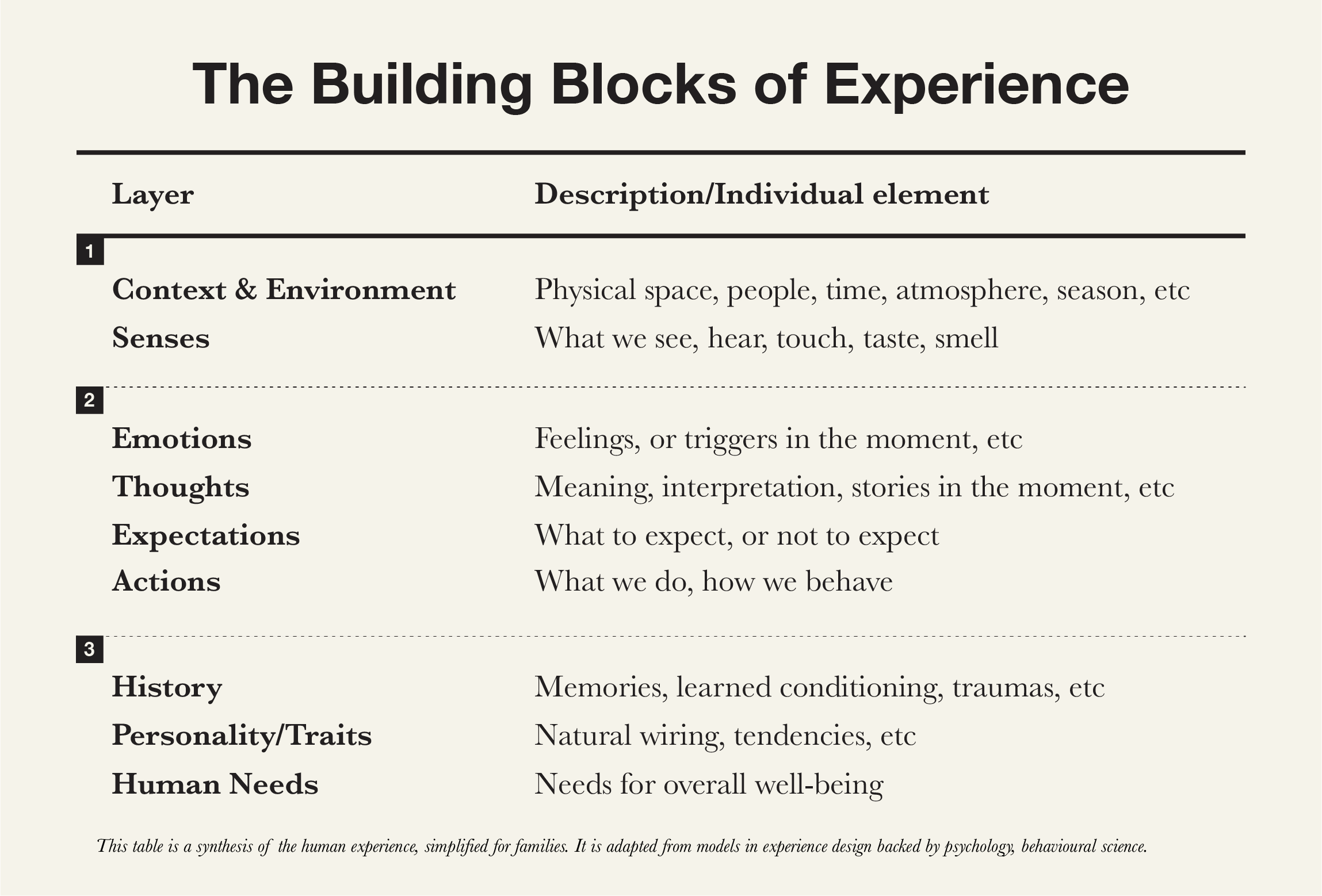
When we experience something, our journey is often not linear (1 > 2 > 3), instead it jumps between layers. Test this out by imagining how you would experience your favourite brand or product, or a house that has been designed specifically for you.
But when designing an experience, we’d typically start from broad psychological human needs, understand what the person is thinking, feeling, or expecting in context, and then decide what we want them to do. Once those are clear, we shape the superficial layers to achieve the goal. Because there is scale in business, we don’t always have to go deep into every layer or use every individual element in order to create an impact.
Experience in the home environment
At home, the principles of experience design are the same. But unlike businesses, families are not able to leverage scale. We are working with unique individuals, so there is a need to put more focus on layer three when designing family culture. Parents can use the experience building blocks to:
Understand ourselves.
Notice our triggers. Identify thoughts and emotions underneath. Rewrite the stories that don’t serve us. Then shape our environment to support the new narrative.Understand our family members.
Listen to what they say. Discuss. Notice how they react. Observe patterns. Use the three experience layers to make sense of what they might need.Assess our current experiences & create intentional experiences.
Look at the family experience on two levels. The overall climate of the home and our small daily interactions with one another. As much as possible, we want to work towards an alignment individually and across both. When there are too many contradictions, the experiences become confusing.
Design is effective because it meets people where they are. When we break down an experience, we are able to nudge each element towards the same direction so it feels good inside.
Parents are a critical part of the environment
“You do not get to design your child. Children are not blank slates on which we write outcomes. What we can do is shape the environment around them in ways that support their wellbeing, not engineer who they become.”
Dr. Russell Barkley, Clinical Psychologist
At home, the environment is most importantly, us, the people. Our tone, our choice of words, our body language, our moods, our triggers, our habits, our reactions.
As we all grow, our environment needs to shift to support who we all are becoming. That also means adjusting ourselves the same way we adjust our physical space from cot to toddler bed to full-size bed.
We will never get everything right. No family does.
But when we understand the small pieces that shape our daily experience, we can shift one experience at a time to create a home environment that feels a little kinder, a little calmer, and a little more us. No dashboards, no real-time updates on our messy inner world. Just by using the very human skills we already have.
The only real counterweight we have over the experiences technology provides is the quality of the human experiences we create, especially the ones at home.
When our children have strong, positive human experiences to anchor to, they will be able to tell the difference between experiences designed out of love and ones designed to keep them hooked. I think that clarity is possibly one of the best gifts we can give them as parents.
Related Posts: How Designers Think
Send your comments and questions on this topic. I’d love to hear your thoughts.